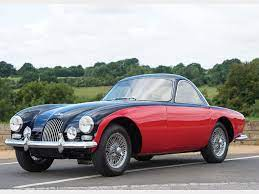
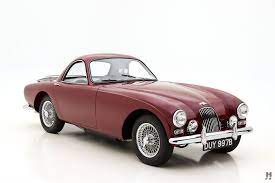
You could be forgiven for thinking that Morgan didn’t produce a fixed-head car until relatively recently, with the introduction of the Aeromax in 2005. But that’s not the case, because back in the Sixties this storied British car maker tried to offer something new: a fixed-head car known as the Plus 4 Plus. The English company got its fingers badly burned in the process—so much that it waited for the better part of half a century before it tried the same thing again.
Founded in 1909 as a maker of three-wheelers, Morgan introduced its first four-wheeler 25 years later. By the time the Plus 4 Plus was unveiled at the 1963 Earls Court Motor Show, Morgan had been building cars for more than half a century. They were all built using the same technique: an ash frame over which steel panels were attached. All Morgans were open-topped with only rudimentary weather protection to that point, so when the fiberglass-bodied Plus 4 Plus was unveiled, Morgan purists were horrified.
Even within Morgan there was dissent over the Plus 4 Plus. In the 1950s Peter Morgan had started to consider the possibility of Morgan producing a fully enclosed car, having seen what Lotus had done with the fiberglass-bodied Elite, Jaguar with its XK140/150 coupé, and MG with the A coupé. But his father and company founder Henry (HFS Morgan) wasn’t convinced; he reckoned that the benefits and durability of fiberglass were not proven. Knowing that the Morgan Plus 4 chassis was somewhat flexible, he was sure that the plastic bodywork would soon crack.
Peter and Henry couldn’t agree on whether or not to embrace this brave new world of plastic-bodied cars, but in 1959 Henry died, leaving his son to run the company. Within a couple of years Peter decided to go for it, and towards the end of 1962 he explored the possibility of an enclosed fiberglass-bodied Morgan with industry experts EB Plastics. This Staffordshire-based company was behind various Ford Pop-based bodyshells as well as the EB Debonair sports saloon, and it also made the cabs for Foden and ERF Trucks plus Austin-Parkinson electric vehicles, so it had a pretty good idea of working with plastics.Reassured by the company’s experience, Peter Morgan commissioned EB Plastics to design and build a prototype fixed-head Morgan, to be based on the existing Plus 4 chassis. The oily bits had to be carried over wholesale, the Morgan family look had to be retained, and the front overhang had to be minimal.
John Edwards, EB Plastics founder, came up with some sketches for Peter Morgan, who reckoned that they hit the spot perfectly. The only chassis change needed would be a pair of sheet steel extensions that bolted either side of the engine, linking the front suspension to the bulkhead, resulting in a much sturdier structure that reduced the chances of the bodyshell cracking. Next step was to create a scale model, and with Peter Morgan happy that things were moving in the right direction, EB Plastics set about building a running prototype on a Morgan-supplied Plus 4 chassis; all production cars would be made in Morgan’s Malvern factory though, with the bodyshells shipped in.
By March 1963 the prototype was complete and Peter Morgan immediately embarked on a road trip with his wife, taking in France and Spain. The extra-stiff front end showed up the unforgiving nature of the Plus 4’s suspension, but other than that the car acquitted itself pretty admirably. John Bolster, technical editor of Autosport, was certainly impressed: “In a veritable cloudburst, I drove along Ross Spur in sheets of spray, reaching 105 mph. The famous controllability of the Morgan was fully in evidence, fast curves being taken at speed in complete confidence.” Such positivity was typical of the press coverage, with reviews citing the car’s excellent build quality.
Despite rave reviews, the Plus 4 Plus was unveiled to gasps of horror at the October 1963 motor show, priced at £1275. With the regular Plus 4 costing just £816, potential buyers reckoned that was a hefty premium to pay for something they considered ugly, even if it was £347 less than Lotus’s rather more sophisticated Elite. Peter Morgan later disclosed that he only ever intended to make and sell 50 examples of the Plus 4 Plus, and the pricing reflected that. Unfortunately for him, 50 copies was rather optimistic …
In a bid to prove the Plus 4 Plus’s worth, Peter Morgan set about racing and rallying the prototype. He and the car performed well and by 1966 it had notched up 50,000 miles, but the Plus 4 Plus’s awkward proportions and the fact that it broke with tradition, meant that it was never going to fly. Over the next four years just 26 examples were made before Morgan cut its losses and struck the Plus 4 Plus from its price list. It would be more than 40 years before the company offered another fixed-head model again. and even then it was only on a limited basis.
I qualified as a Quantity Surveyor in 1965 and started work in the family plumbing and specialised piping company in Pretoria ( Dawson and Fraser). The company was involved in contacts all over the country, resulting in me doing a lot of travelling.
In May 1980, my secretary, Estelle Marais (24 years of age and recently married) arrived at office as usual in the morning topless (she always came to work in her Sunbeam Alpine (1961) with the hood down). I said to her that morning that I would really like to acquire a sports car. She suggested I look at a Morgan. At that stage I had never seen a Morgan.
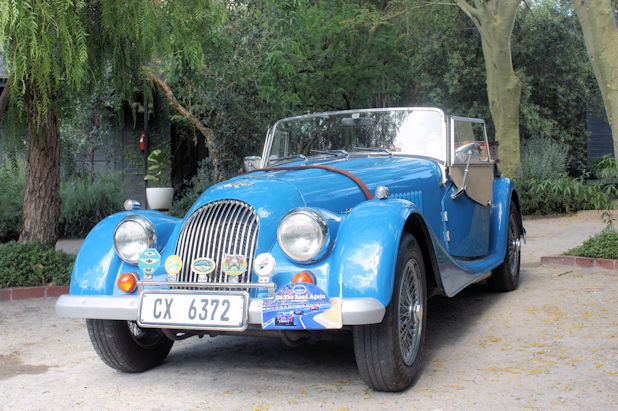
A week later Estelle arrived in office with a Morgan catalogue which she got from her cousin Terry Allen, I immediately fell in love with the pictures and selected the 4-seater, 4/4, so that my 3 very young daughters could sit on the back seat when we used the car. With Estelle’s help I selected the turquoise blue from the catalogue, wanting to be a little different from the usual British racing green.
I placed my order with Angela Heinz via Terry in June 1980. The waiting list at that time was 40 months, however because it was a export order I was very lucky and was advised by Angela that my car would be ready In May 1981. I received my Pro forma invoice on the 27th of March, 1981 for the amount of 6862 Pounds including shipping. 1 Pound was then equal to R1,80. Landed cost was R12 351 ex Durban and, with import duty, the total cost was R 20 000. I arranged the import permit and paid Morgan UK who then paid Angela her 17,5% commission.
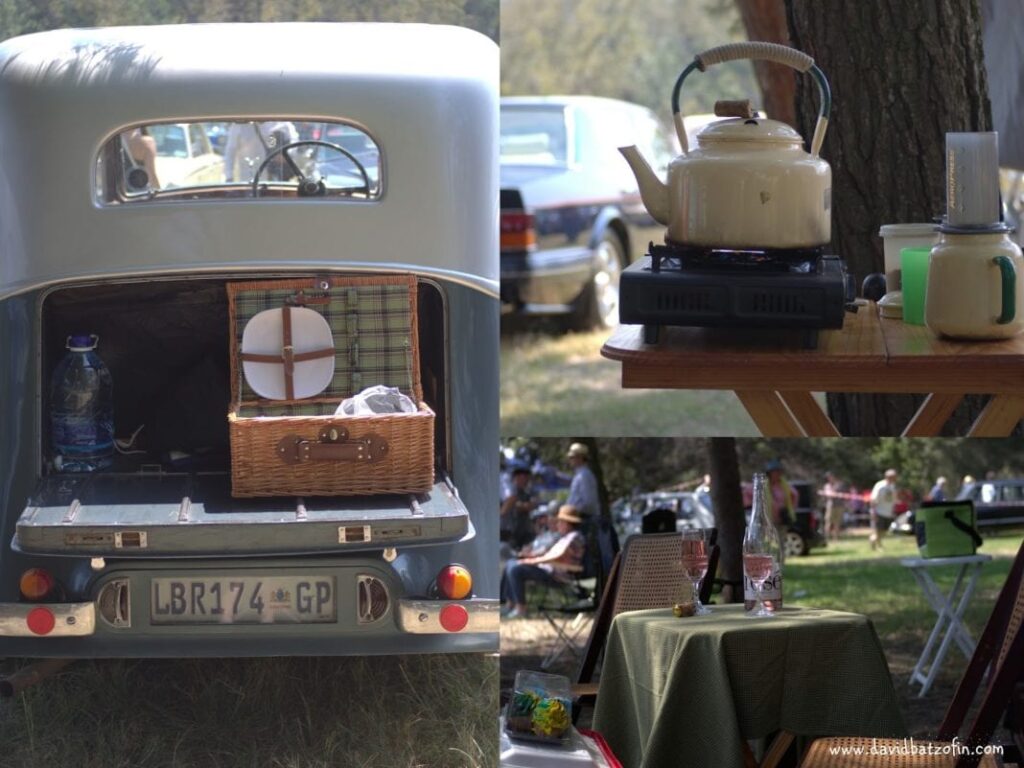
On the 18 May, I was informed by a Mr. D J Day (from the factory} that my car had been loaded on the ship “Aniello” and was on the way to Durban. It arrived the 2nd of July; however, there was damage to the front bumper and the wind screen had to be replaced. I went to Durban and collected the car and drove it back to Pretoria, very, very pleased and happy. We happily attended to 2 of Angela’s picnics in Johannesburg and met a number of fellow Mog owners.
The paint at the corner of the bonnet was chipping off and the guys at the picnic told me that if it did not chip off it was not a Morgan. I did however fit safety belts to the car which I have always regretted, I believe that if the car ever flipped in an accident you could be squashed to death, but I do use them.
In 1983 I left Pretoria and went farming at Zebediela, near Potgietersrus, where I farmed with citrus, table grapes, cotton and cattle. The farm was 46km from town, of which 25km was on a bad gravel road. As a result, the car spent a lot of the time in an open garage with lots of dust and was not driven for long periods. The cat loved sleeping in the car resulting in some minor damage to the upholstery.
We moved to Plett in 2000, driving the car down and soon after joined the CapeMog club, allowing us for the first time to really enjoy the car and meet some wonderful people.
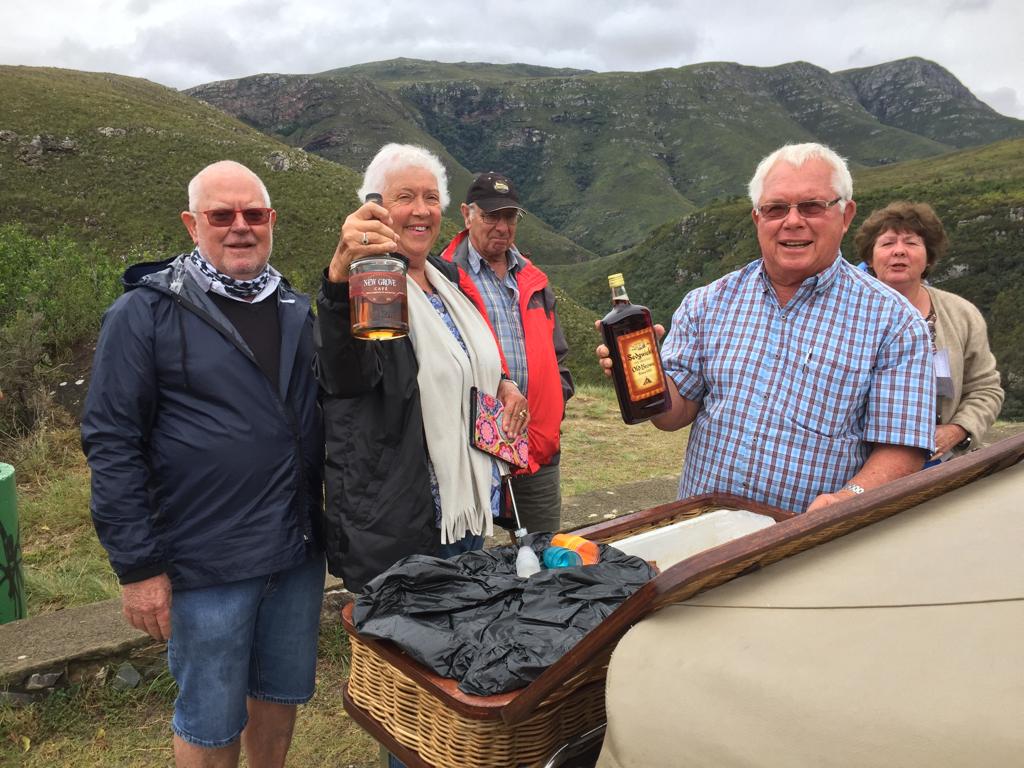
Candy and I have had the pleasure of participating in 11 wonderful annual tours with the club. These tours provided us the opportunity of visiting and seeing parts of the beautiful Cape that we would never have seen otherwise. I soon realised that I needed a basket for the liquid padkos and thanks to Don Steenkamp who kindly made the bracket for the basket. I have a monkey on the basket that safeguards the contents.
Providing anti-freeze on a cold day
In the 40 years I have had only a few minor problems with the car which still goes very well. I had to replace the brake shoes, clutch cable, windscreen, exhaust pipe, diff oil seal and a leaking petrol tank, all rather minor.
Because of a little over heating, I had an electric fan fitted behind the radiator. The car has now done 38000 miles and has a 1600 Ford Kent engine with the first number plate being my initials, FJF068T.
We love our car; and I really believe we can drive on some of the gravel roads if they are not too stony.
So, we can thank my young secretary and her cousin for getting a car that has given Candy and I many hours of pure windy pleasure, from light snow to rain and burning heat and we very rarely put the top up.
Undoubtedly a unique offering from Wales, we drive one of the few Morgan 3-Wheelers in South Africa.
Words: Wilhelm Lutjeharms
Images: Simon Luckhoff
The fact that the Morgan Motor Company has continued to produce their cars through all these decades, is quite an achievement. Founded in 1910, one of the first cars the company produced was a three-wheeler fitted with V-twin-cylinder engine.
Around two decades later these models were developed into more sporty-oriented cars. But, in 1952 the last three-wheeled Morgans were manufactured until Morgan reintroduced the model in 2011 at the Geneva Motor Show. Next up, as we know, Morgan completely redesigned this concept and only a few months ago they unveiled the third generation 3-Wheeler, now called the Super 3.
I personally have a soft spot for this company as my late dad and I spent a weekend in a Morgan, although it being a standard four-wheel version, driving through Wales a few years before he passed away. Driving a Morgan through Wales is not dissimilar to driving a Ferrari through Italy. The locals love this product and the history behind it.
However, a 3-Wheeler has always been one of the quintessential Morgan models and in 2022 it especially stands out, even more than ever before. I was definitely not going to pass by a chance to spend some time with one.
THE DETAILS
This looks like a very compact car for starters, and even more so when you climb inside. If you are a little padded around the hips, you simply won’t fit. But once you are snugly seated, the simplicity of this car and the pseudo aeronautical instruments quickly get you into the mood of what you are about to experience. There are also two small screens to deflect at least some air away from your head.
The open air enjoyment is a given, and so is the fact that the exhaust pipe is right next to your body. Your legs are stretched out in front of you to the beautiful floor-mounted pedal box, while the steering wheel can unclip to make ingress and egress slightly easier.
The gearlever is close to the steering wheel and the handbrake right next to it. Indicating just under 1 800 km, this 2014-year model is basically brand new – and it shows, being a one-owner car.
BEHIND THE WHEEL
One of the joys from behind the wheel is the fact that you can see the right wheel, suspension assembly and exactly how it functions as you drive. You can even, to some extent, see a part of the left wheel moving up and down.
The clutch takes quickly and thoroughly, while the five-speed gearbox (the same unit used in Mazda’s MX-5) offers short throws and direct changes. This leads to a very engaging driving experience. Secondly there is the S&S, twin-cylinder engine, visually one of the many appealing features of the car. This unit does lead to some old-school rumble and vibration through the car, although slightly less than I expected, while you also constantly have the soothing twin-beat from the exhaust note.
Weighing only 525 kg, there is enough torque to have fun though. Acceleration feels brisk and possibly in line with the claimed 0-100kph time of 6 seconds, while being such a complete open-air experience allows you to intimately indulge in your immediate surroundings.
The engine is not happy to potter around 2 000 rpm or lower, but from there on up it easily revs to over 4 000 rpm. In the end it is more fun to make use of the torque lower down in the rev range than to chase the redline.
Although on-the-limit driving is not what this vehicle has been designed for, I can only assume that grip levels are rather low, and with some quality time behind the wheel you will surely be able to drive it in a rather fun manner.
Even so, the three-spoke steering wheel offers good feedback and the brake pedal lowers your speed comfortably.
PRACTICALITY
Of course, there is no space inside the “cabin”. If you think you can leave your wallet or phone in your trouser pockets, you will be making a mistake. However, one small storage tray was able to accommodate my wallet and smartphone. But, the neat tail piece behind the cockpit opens up with two latches. Here is enough space for two – very small – soft bags, or maybe two warm jackets. The choice is yours.
UNLIKE ANYTHING ELSE
In the end, the Morgan 3-Wheeler offers an experience unlike any other car I’ve driven. Morgan has taken the concept of the original and eloquently mixed it with modern technology. The rawness of the driving experience, the fact that you can see part of the frame in the cockpit and sit so close to the road while being completely in the open, contribute to a truly unique driving experience. Also, everywhere we went all the people: children, men, women and security guards, smiled waved or asked questions about the car. That doesn’t happen often.
Thanks to The Archive for making this drive possible, where this car is now for sale. Visit their website or contact them directly on 021 812 0450.
Angela will be remembered by most for Angela’s Picnic. Remembered by the many 1000s who have attended the event over the last 30+ years mainly at Delta Park. SAMCA – South African Marque Clubs Assn. was formed by 6 classic car clubs (Austin Healey, MG, Triumph, Alfa Romeo, I think Lancia and Morgan) over 30 years back. Very soon after its formation Angela suggested a laid-back, totally uncompetitive, picnic in the park for all owners of interesting cars – whether members of SAMCA or not. After Angela died of cancer it was considered appropriate to take a collection at the entrance to the park for the Cancer Association. Subsequently the beneficiary was changed to Hospice. Well over R 700 000.00 has been donated in Angela’s name to the immense credit of SAMCA.
What not many in the Classic Car fraternity know is that Angela also ran Friends of the Opera. She visited Bayreuth in Germany most years for the Wagner festival. On her annual sorties abroad she would visit England to collect Edwina, her Rolls Royce which took her all over the continent including behind the iron Curtain.
Angela was the Morgan agent in South Africa for over 25 years and ordered one of the first +8s ever made in 1968. It was originally supplied in undercoat because she couldn’t decide on a colour. The final paint (a metallic green – before it was rebuilt in framboise frappe – pink to you Charlie!) was applied here. This was probably the only Morgan to leave the factory starkers.
She was a leading light in the Doberman club inviting and hosting many top judges from overseas. She was a member of the Swiss Rifle club though I know not of what their activities consisted. She was the first South Africa Agent for Nava Helmets, KTM Motorcycles, Bilstein Shock absorbers and was I understand the first woman member of the Motor Industries Federation. She rode her own KTM and visited the Roof of Africa Rally many times in her Jeep. She managed to tip this vehicle nose over tail while going up too steep a slope. She raced hotrods at the old Wembley Stadium. Angela started writing a book on gargoyles of which she had thousands of photographs from all over the world. She also flew her own crop-sprayer.
Angela’s dinner parties at no.6 The Munro Drive, Houghton were legendary. Over 20 people could be seated at her table in the dining-room with candles being the only light source. 66 candles if I remember correctly. I put them out with the snuffer on at least one occasion. The view from the dining-room window was amazing. I’m sure I saw the Voortrekker Monument one clear day. You were invited to dinner on the basis of how interesting you might be and what you could contribute. Seating was done according to how you may, or may not get on with your neighbours. I don’t remember leaving before 2:00 a.m. – ever!
Angela’s family name was Jordan and her father was Kirchoff’s Seeds. I remember a discussion amongst a few people bragging about how their family names had become part of history. She suggested that there was nothing to which her family had given its name – except perhaps that river between Israel and Jordan. A magic lady – remembered by all who knew her with immense affection and admiration.
Long may she be remembered.
Terry M. Allan (2019) – 082 412 0371
……………………………………………………………………………………………..After Angela died , SAMCA continued to stage Angela’s picnic and a collection is made at the picnic every year, which is donated to the South African Hospice Association. Over the years SAMCA has collected and donated up to R700,000-00 to organizations for cancer sufferers and terminally ill people. For the past 2 years Covid lockdown regulations have prevented the event from being held.
On a lovely hot July Sunday, I climbed into my pride and joy, my Morgan Aero8 and with my dog Murphy; dropped my partner Jan at the airport and cruised down the M2 motorway towards Belfast. My mind was still rejoicing on the previous two weeks of driving in France. I was in the middle lane of the motorway, just following the drifting traffic into town with the soft wind blowing my hair and listening to R5 Live and Rory MacIroy trying to win the Open. I was following a maroon Mini. In an instant he swerved into the outside lane and there to replace him in the same lane, 15 metres away was a silver car at speed facing ME. No time. No alternatives. No escape. —————- TWO WEEKS EARLIER ——- Jan and I, all packed up in our two-year-old Morgan Aero8 series 5, headed down Ireland to Cork in 28 degrees. A pleasant tour of the city and on to the overnight ferry to Roscoff. We arrived at the French port next day and headed for Nantes to stay with French friends, Jan’s business colleague Jacques Soignon and his wife Regine Jacques is a European leader on urban Green Space planning and creating Nature Cities. Anyone passing this area must stop and see how a city can morph its environment from an once struggling Atlantic port city to the most successful inward investment area in Europe, along with bike and pedestrian friendly tourism. Creative stars are the giant puppets (30 foot high wooden elephant, human figures and a new heron tree of life). All this new art construction using the old shipbuilding hangers and warehouses. Off again to Le Mans 24 Classic Race with a hotel on the Mulsanne Straight for four great and noisy days and nights. One big fiesta with lots of great Morgan people and their cars dominating the hotel. Off again to the sea onto the peninsular of Noirmoutier-en-l’Ile, across a two mile causeway, only open a few houses every 12 when the tide is low. See the high tide picture !
Five relaxing and quiet days followed, cycling and on the beach, eating local mussels and oysters watching the closing chapters for England at the World Cup amidst the jubilant French. What a journey of three contrasting places! We drifted home via Normandy and D Day areas, took the ferry and back up Ireland. Through 1,700 miles we had the roof down every minute and never put it up at night either, thanks to a neat storm cover from Kit- Kat. . Home a few days basking in the memories and my perfect car. I have been a Morgan driver for 34 years, with a first order for one in 1977. This one was the best. And now…………..
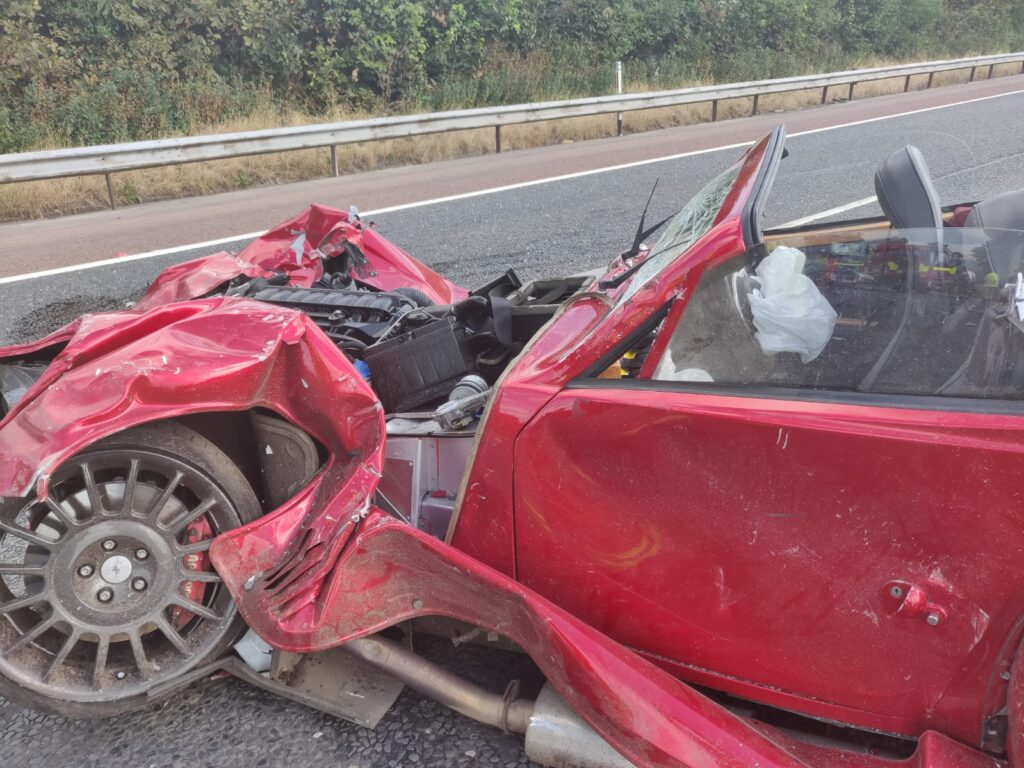
BUT there is a flash of a car coming through between two cars and the wrong way at probably 60 /70 MPH matching my 65 MPH . Noise and glass..pain..smoke and metal everywhere. Some other cars caught in the collateral damage. The Morgan had nothing left in front but the V8 engine block; doors crumpled; cars everywhere. The engine and gearbox of the other car was up the road! Miraculously, I unclipped and slid up out of the seat. People came up to help and were astonished I was alive. Also Murphy is in the passenger footwell and was alive; the golf commentary was still going.
The cockpit stayed solid through all this with the big engine not giving in to the compression. I was off to Hospital for the day and released with unbelievably no injuries to me. Murphy was checked by the vet and released too. Thanks to Morgan for the strong build, you saved my life. The police and Fire brigade agreed Very sadly the oncoming driver did not survive. Maybe it was fate that the Aero8 was hit. The police said any small engine car and I would not be here.
Airbags deployed
Engine of the other car on the far left
Better notto dwell, but my first call Monday morning was to Morgan..
Morgan Motor Company was born in 1909 when its founder, Henry Frederick Stanley Morgan, decided to make his own cars in the town of Malvern, Worcestershire.
That year, he created the company’s first prototype of its iconic Three-Wheeler model – the Runabout, which was initially invented for his own personal use at the time. The one-seater Runabout was not originally intended as a commercial venture until the promising reaction to Morgan’s creation encouraged him to put the car into production.
A year later, the Runabout was unveiled at the 1910 Olympia Motor Show in London. Powered by a 7bhp Peugeot V-Twin engine mated to a tubular steel chassis, the light nature of the car meant it had a unique power-to-weight ratio of 90bhp per tonne; making it one of the fastest accelerating vehicles at that time.
In 1912, Morgan Motor Company officially formed as a private limited company, with HFS Morgan as managing director and his father George Morgan, who had invested considerably in his son’s business, as its first chairman. The car maker began flexing its competitive muscle when in 1913 it won the International Cyclecar Grand Prix at Amiens in France, beating strong opposition from many continental four-wheelers. That same year also saw a Morgan achieve the fastest time at the celebrated Shelsley Walsh Hill Climb at an average speed of 22mph. The three-wheeler model used became the basis for the Grand Prix, Aero and Sports models between 1913 and 1926.
Due to increased demand following these victories, in December 1913 HFS Morgan purchased a large plot of land on Pickersleigh Road – a quarter of a mile from the original Worcester Road factory – and proceeded to build two large workshops on the plot, to this day the site for the current plant and known traditionally as the ‘Works’.
New models were being added to the Morgan range and in 1921 a four-seater family ‘Runabout’ was available for the first time.
In 1933, the Morgan F-4 debuted at that year’s Olympia Motor Show. Rather than the tubular steel chassis, the four-seater F-4 used a Z-section steel ladder-frame chassis mated to a four-cylinder Ford Sidevalve engine used in the Model Y. The F-4 was supplemented by the two-seater F-2 in 1935 with production of the Ford-engine three-wheelers continuing until 1952.
Three years later and Morgan’s first four-wheel car, the 4-4 sports car, was revealed at the London and Paris exhibitions. The 4-4 – indicating four wheels and four cylinders – was an immediate success with four-seater and Drophead coupé versions arriving shortly thereafter. Still in production today, the Morgan 4-4 holds the record for the world’s longest production run of the same model. Alongside the 4-4, the three-wheeler remained in production until 1952 although sales of the V-twin engined cars were in decline.
Fast forward to 1950 and the Morgan Plus 4 was launched. Initially powered by a 2088cc Vanguard unit that developed 68bhp, later Plus 4s used Triumph TR2-TR4 engines from 1954 to 1969.
Plus 4 with TR 3 engine
A lull period for Plus 4 production occurred in 1969 and didn’t resume until 1985 when a 2.0-litre inline-four cylinder Fiat engine was used for three years, followed by a four-cylinder Rover engine. The Plus 4 returned again in 2004, this time with a potent 155bhp 2.0-litre Ford unit dropped into the body.
In 1955 the Morgan 4/4 became the Series II 4-4 and was of similar design to the Plus 4, but fitted with a smaller 36bhp Ford side valve engine and integral gearbox; the objective being to provide a sports car with lively performance for the enthusiast with modest means.
In 1959 the bespoke British carmaker suffered a great loss when the company’s founder HFS Morgan died. Known as ‘Harry’ by family and friends, he was one of the great innovators of motoring and highly respected throughout the industry. Peter Morgan, son of HFS, took over the reins of the company until a few years before his death in 2003.
In 1966 the Triumph TR engine was coming to the end of its life and so Morgan struck a deal with Rover to use the aluminium Rover 3.5-litre V8 engine – spawning the Morgan Plus 8 in 1968. By 1983, the Rover EFI V8’s power was up to 204bhp, which allied to a kerb weight of 851kg, made for a 0-60mph time of 5.6sec for the Plus 8 – enough to give Porsche 911 owners of that time a sweaty brow. The Morgan Plus 8 proved to be one of the most successful cars for the company and production continued for 36 years right up to its discontinuation in 2004.
Morgan Plus 8
The same year production of the Plus 8 ceased, the traditionally styled roadster debuted, powered by a 3.0-litre 24-valve V6 derived from the Ford Mondeo. The resultant shoehorning of said lump helped the roadster accelerate from 0-62mph in 4.9sec and onto a top speed of 134mph. In 2011 the engine was replaced with a Ford 3.7-litre Duratec Cyclone V6 with a power hike to 280bhp. In 2000 Morgan took a punt launching the Aero 8 – the first new Morgan design since 1948 and the first Morgan vehicle with an aluminium chassis and frame as opposed to the traditional aluminium skinned wooden body tub on a steel chassis. Originally powered by a 4.4-litre BMW V8 mated to a six-speed Getrag transmission, in 2008 the Aero 8 received BMW’s 367bhp 4.8-litre V8 and an optional automatic transmission became available
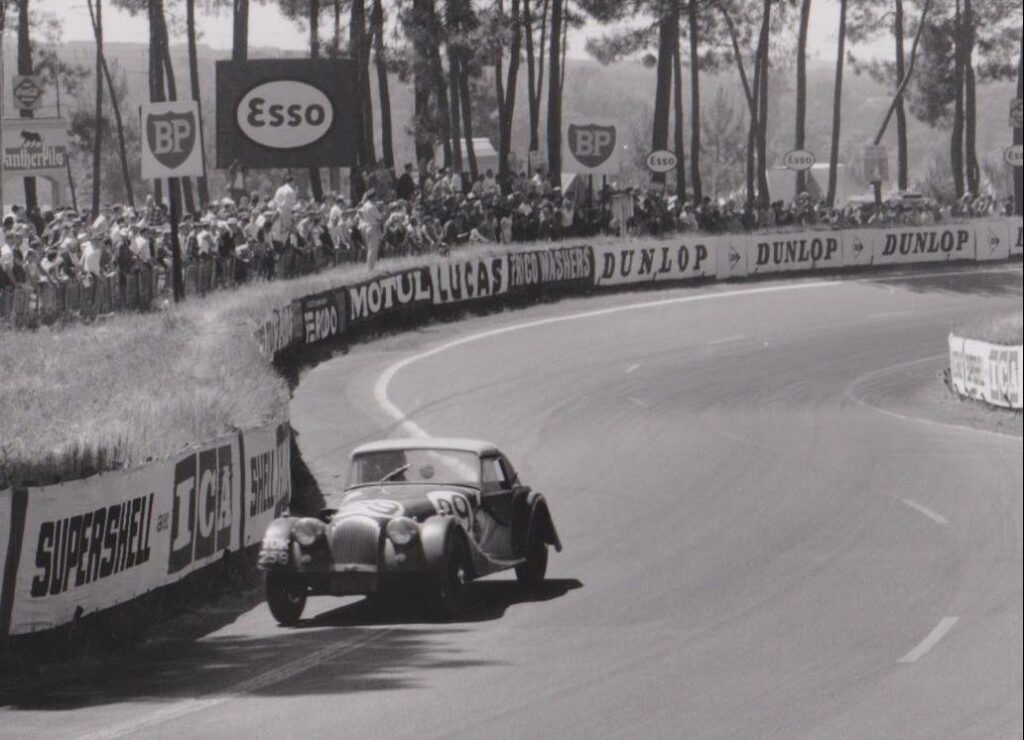
It was a result that belied expectations, if only among the doubters. In 1962, a Morgan claimed class honours in the Le Mans 24 Hours. It did so against the odds. In fact, the humble Morgan was the butt of many a joke during the build-up to the race but by the time the flag fell it had proved itself against tough competition – and the sniping stopped.
For Christopher Lawrence, who masterminded the bid, co-drove the car, and a lot more besides, there was the satisfaction of a job well done, but that’s about it. He never was one for hype or eulogy, and certainly not one to court media attention. Lawrence, who died in 2011, aged 78, didn’t like a fuss and, when comfortably into his autumn years, he still couldn’t fathom why anyone would be interested in writing about him. He was, however, a fascinating man, if perhaps not one to suffer fools gladly, or otherwise. He would dismiss himself as a ‘travelling chicane’ whenever talk turned to his briefest of spells as a Grand Prix driver. He would then trump that by professing to being a hopeless businessman, and it’s certainly true that not all of his commercial affairs ended well. And that’s before you ran into the thicket of some of his design and engineering projects, which included everything from twin-engined single-seaters to the tragically short-lived Monica luxury saloon. Yet he achieved great things, during his career as an engineer, racer and sailor.
Lawrence’s links with Morgan stretched back to his teenage years. Inheriting an interest in two-wheeled machinery from his father, Lawrence switched to three wheels in 1952 after persuading his mother to buy him a 1936 Super Sports for his seventeenth birthday. Predictably, he soon began campaigning the JAP-powered Morgan trike while also adding exotica such as a Bugatti Type 38 into the mix during his spell at the Royal Navy Engineering College in Plymouth. He found a novel way of supplementing his income, too. Lawrence thought laterally — and vertically — and became a Wall of Death daredevil riding an old Indian motorcycle.
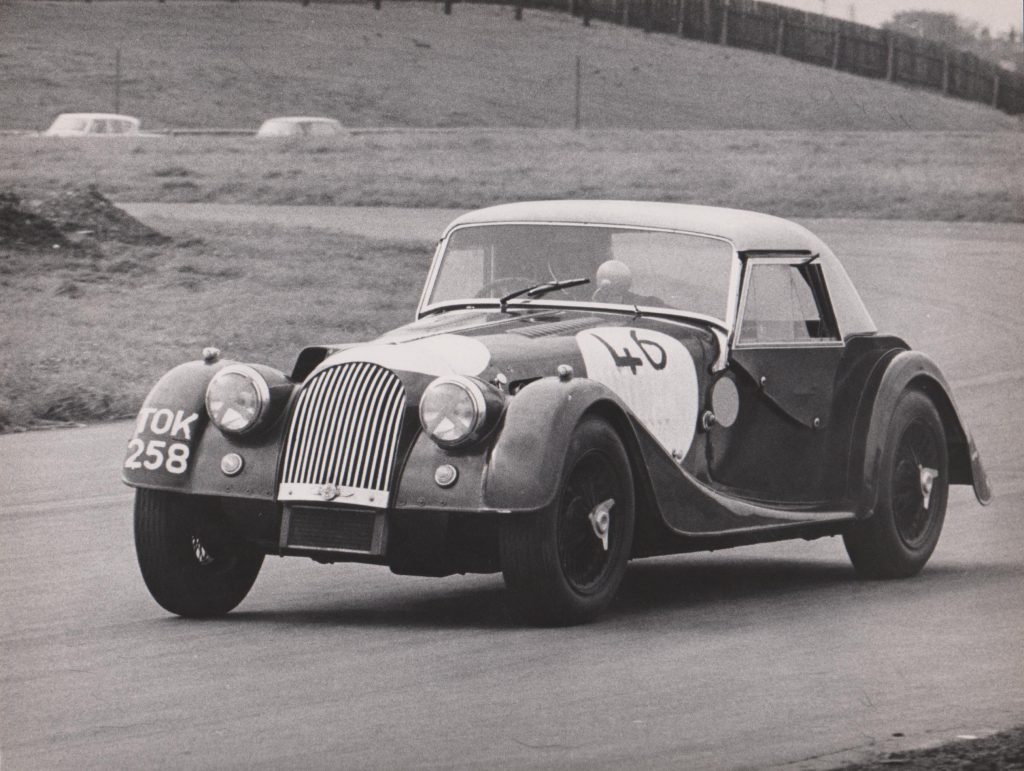
Following further circuit outings aboard an ex-works MG Magnette, which ultimately gained a glassfibre Microplas bodyshell, and a BMW-powered AFM, Lawrence found greater fame with a second-hand Morgan Plus 4. “I bought ‘TOK 258’ for £650 and then together with Leslie Fagg and Len Bridge set about preparing it for the Freddie Dixon Trophy, which was a BARC [British Automobile Racing Club] championship. My first race with it was on my birthday, July 27 1958. I finished last,” he once told me. He claimed the title a year later, taking 19 wins from 23 starts along the way, which prompted his decision to form LawrenceTune. His premises in Acton, West London, swiftly became the centre of the universe for Morgan types.
Lawrence’s status as the Morgan racer and turner par excellence reached fever pitch after he and team-mate Richard Sheppard-Barron claimed class honours at Le Mans. This upset win almost didn’t happen.“We had been getting superb results at home, while also showing well in major international races, and then we decided to do Le Mans. I bought a car from Peter Morgan [registration ‘XRX1’] and entered it for the 1961 race. All went well to begin with. We got through scrutineering, had gone through all the various stages of the process, but then we needed the final approval stamp. Basically, this meant we were officially signed off and could go out on track and practice.”
TOK 258 Morgan Le Mans car
And then it all began to unravel, as the the Automobile Club de l’Ouest organising body made an about-turn. “We waited, and waited, and it became clear that all was not right. I didn’t know any French at that time. Nor did Richard, for that matter. Then the ACO threw us out. I was getting angrier by the minute because there was no explanation until, at long last, the ACO secretary informed us that, despite all the homologation paperwork being in order, the Morgan somehow wasn’t in the spirit of the race; we had entered a car from 1939 and added disc brakes. What he was saying, in essence, was that we were an embarrassment.
“I found out many years later that Triumph’s team manager, Ken Richardson, had nobbled us. He didn’t want his works cars being shown up by a Triumph-powered Morgan. He had threatened to withdraw his three works TRs if we were allowed to run.” Unbowed, but vengeful, Lawrence and his plucky squad returned the following June. “I went to Peter Morgan and twisted his arm: he was going to submit our entry for the 1962 race because the ACO wasn’t about to turn down a works team. Peter thought there was far more to lose from ignominious failure than there was likely to be gained, but he did what we asked. Nevertheless, I still paid.
“I then upset him a little bit. I was going to run TOK 258 but wanted to replace the existing body with one from a 4/4 model which had a lower body line and reduced frontal area. Peter refused to help, saying, ‘I can’t mix up my models because it will only confuse people,’ so I surreptitiously bought parts from the sales department and assembled a body in Acton, with Charlie Williams [of famed metal-shapers Williams & Pritchard] making us a hardtop. We then painted it burgundy — TOK had always been that colour — and went off for the Le Mans test weekend.”
Lawrence’s subterfuge soon became all too apparent. “The ACO wrote to Peter saying how well the car had gone but could we change the colour to British Racing Green? Naturally, I refused; it wasn’t compulsory and, besides, I couldn’t afford to have it resprayed again. Peter then told me to bring it to the factory and he would get it done. I sent [LawrenceTune works manager] Len Bridge to drop it off and told him to do so very, very early. I knew that by about 9.55am the phone would light up — I was about eight minutes off. I had never known Peter be so angry. I had been mixing up his models and everyone who’d seen the car wanted one; I had been underhand and dishonest, and so on. He phoned me again later that day by which time he had calmed down. He announced that he was going to introduce a new model — a replica of my car — and it was going to be called the Plus 4 Supersports. ‘What’s more, you’re going to build the engines,’ he insisted.” The race-winning Morgan continued to be campaigned for decades to come
In doing so, Morgan created a bit of history on the quiet. This marked the first time that a manufacturer had covered a car tuned by an outside company under its own warranty. As for the Le Mans bid, inevitably there were sniggers from some quarters about this funny little car being allowed to enter. There was also the small matter of running the gauntlet of scrutineering. “There were 26 stations you which you had to navigate,” Lawrence explained. “Each one concerned a particular and very specific aspect of the car. God help you if your allotted time was after lunch because they did enjoy their food. Eventually, though, we made it through and practice was pretty uneventful.”So, too, was the race. “The funny thing is, I knew we were going to do well. I was pretty sanguine about it.”
Having made a demon start, it became a case of remaining disciplined. Bolstered by Complan, a powdered-milk-based energy drink, the duo droned around with metronomic regularity. Only a fractured exhaust manifold late in the day blunted their performance, and even then there was only a 200rpm drop-off from their strictly-imposed 5500rpm maximum. Their progress was also aided somewhat by the retirement of their team’s principal category rival, the Equipe Chardonnet AC Ace, during the early running. At 4pm on Sunday, June 24 1962, Lawrence stood on the pit counter alongside Peter Morgan and watched Shepherd-Barron guide TOK 258 home. After more than 2,255 miles run at an average running speed of almost 94mph, they had finished thirteenth overall from 55 starters and also bagged two-litre GT honours. “That was my first and most successful Le Mans race,” Lawrence recalled. “The French crowd showed real affection for the car and it was absolutely swamped afterwards. That said, even though what we did is well known today, the press took little or no notice at the time. If we got a mention, it was usually a few lines saying that a Morgan had somehow won its class.”
Returning a year on with his own design of sports car — the groovily-named Deep Sanderson 301 — he would once again fall foul of the ACO. “I drove for 15 hours and 23 minutes with no brakes. I often hear drivers claim their brakes don’t work and mutter under my breath, ‘If you press too hard, too late, then they usually don’t.’ In this instance, the pedal was on the bulkhead: [team-mate] Chris Spender had gone into the sandpit and beat the brakes to hell. Later on in the race, we pulled 153mph down the straight — with a one-litre Downton-tuned Mini engine — and were catching the class-leading DB-Panhard at a rate of 25 seconds a lap. We were then given the choice of retiring the car or having it disqualified. As it happens, there were no finishers in the one-litre class. The only ‘running’ car was in parc fermé.”
Other attempts would follow, before Lawrence headed Stateside where he immersed himself in the historic racing community, both as a car builder and as a driver. He would return from his self-imposed exile during the 1990s to engineer the Marcos LM600 Le Mans challenger before designing the Morgan Aero 8’s award-winning foundations and appropriately overseeing the marque’s return to the great race in 2002. That same year also saw the Morgan Motor Company produce a run of eighty ‘Le Mans ’62’ limited editions to celebrate the fortieth anniversary of its greatest-ever international motor sport success. Lawrence retired shortly thereafter, even if he sometimes forgot. He wasn’t one to watch the grass grow.
This defiantly self-directed racer, engineer, designer and engine-builder passed away peacefully at age 78 on August 13 2011